Diablo IV on a Mac with a controller
 The Diablo IV layout is built into InputConfig, free on the Mac App Store. You don't have to make an account, there are no subscriptions, and nothing is locked. Optimized for Apple silicon.
On a Mac: No Mac version. It plays on a Mac through a Windows PC you stream from or a cloud service that carries it, which normally hands a controller to the game's excellent native scheme. This layout is the mouse-and-keyboard Diablo from a pad, for when the stream does not see the pad.
You can play Diablo IV on a Mac with a controller through a stream, from your own Windows PC or a cloud service that carries it, because there is no Mac version. A stream usually passes the pad to the game's native scheme, which is the right way to play: direct control of your character and abilities on the face buttons.
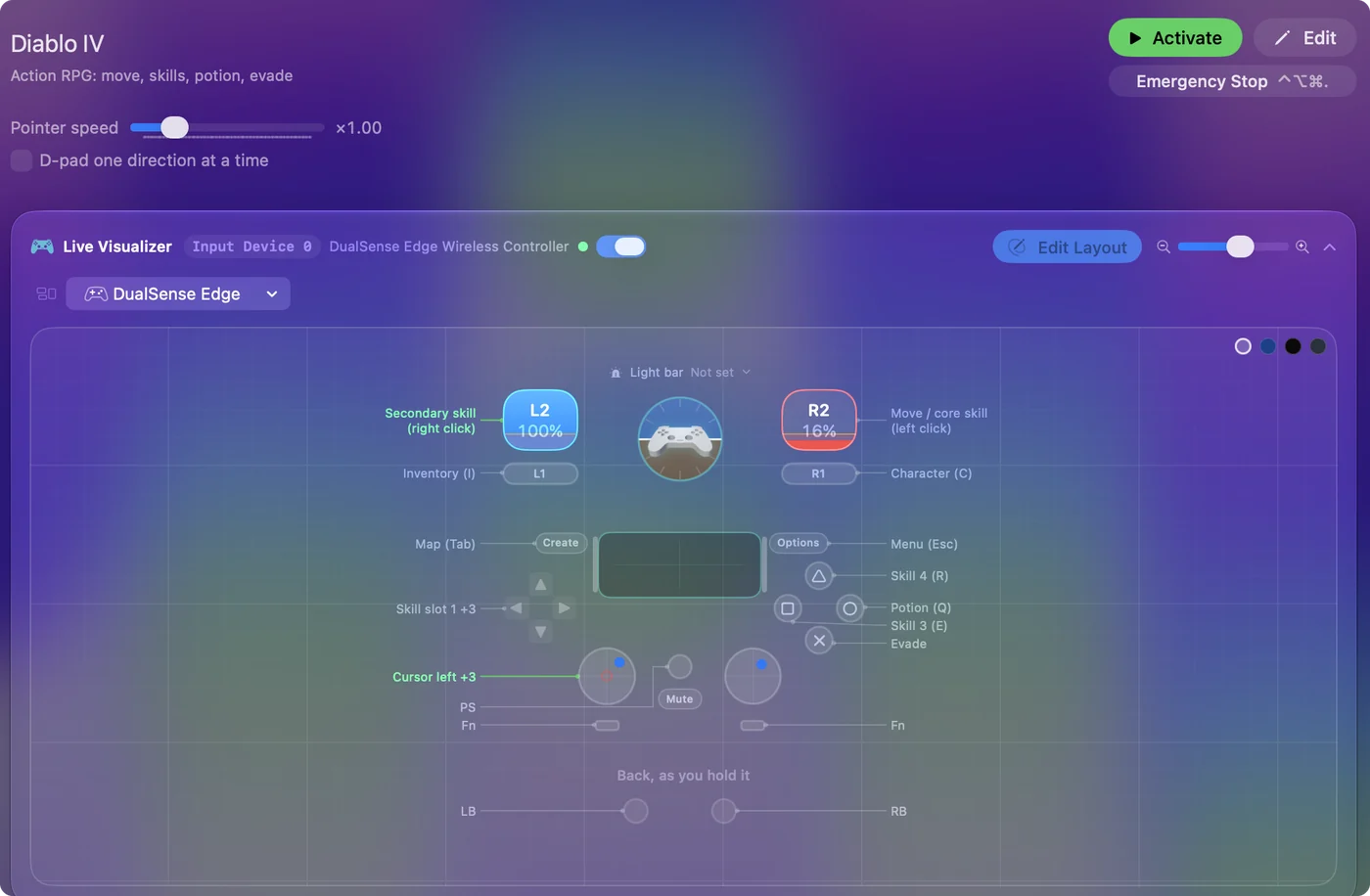
This layout is for the stream that does not see the pad. It is the mouse game, with the cursor on the left stick, move and core skill on the right trigger, and the action bar on the D-pad. It has one real advantage over the native scheme: you can target a specific tile, which in Sanctuary occasionally matters.
On this page: 9 sections
The layout, control by control
How the layout thinks
- Cursor. The left stick.
- Skills on the triggers. The right trigger is left click: move, and the core skill on an enemy. The left trigger is right click, the secondary skill.
- Face buttons. Evade on the bottom, potion (Q) on the right, skill 4 (R) on the top. The left button sends E, which the game uses for skill 3 and for interact when there is something to interact with.
- Action bar. Skill slots 1 to 4 on the D-pad.
- Menus. Inventory (I) and character (C) on the bumpers, the map (Tab) on Create, Escape on Options.
Evade and potion sit under the thumb, because those are the presses that keep you alive.
Tune it to how you play
- Force move. Set a force-move key in the game and put it on the left stick click, so a click never attacks the wrong thing.
- Stand still. Shift, held, casts without moving. Add a right trigger row with While holding set to L1 that sends Shift plus left click.
- Channeled skills. They are held keys. Set that D-pad row to Toggles on and off to keep a whirlwind going.
- Cursor speed. Diablo wants a fast cursor. Raise it to 22 or use Aggressive, and keep a slow speed behind a bumper for picking up loot.
- Loot labels. Alt shows item labels. A spare button set to Toggles on and off keeps them shown.
A fast cursor for fights and a slow one behind a bumper for loot is the setup that works.
If the stream already sees your pad
Use the native scheme for most play: direct movement and abilities on buttons beat any mouse layout. Leave this preset off while you do, because InputConfig does not hide the controller and a press would arrive twice.
Keep the layout for exact-tile targeting and for the day the stream stops seeing the pad.
Diablo IV controller support: controller or keyboard
Steam's store page lists full controller support for Diablo IV, so the game was made to be played on a controller, menus included. A keyboard and mouse work as well, and the choice is yours. On a Mac, use the game's own controller support first when it sees your pad; this layout is for a pad it does not see, or for buttons it will not let you move. Full support listed means the controller is a first-class way to play Diablo IV.
From Steam's listing, checked in October 2026. Every game's listing is in Mac games with controller support.
If your controller is not working in Diablo IV
When Diablo IV does not react to your controller on a Mac, climb this ladder, smallest step first:
- Check that the Mac sees the controller. Open the gamepad tester and press a button. If nothing lights up there, the problem is the connection, and a controller that is connected but not working covers that first.
- Press a button after the stream has started. A stream only picks up a controller that is paired with the Mac, and a browser shows a controller to a page only after a button press. Start Diablo IV, then press any button.
- Play it from keys. If Diablo IV still ignores the pad, activate this layout. It sends the keyboard and mouse controls Diablo IV already reads. Turn the game's own controller option off while it runs, or a press can arrive twice. The layout works whether or not Diablo IV ever sees the controller.
Get it in two clicks
- Get InputConfig free on the Mac App Store, open it, and click Smart Preset Maker on the welcome screen.
- Search for Diablo IV and pick it. The layout is created as a preset in your sidebar, named and ready.
- Press Activate. Every row can be changed afterwards: the editor's Scan button rebinds any control the moment you touch it.
To check the controller itself first, the gamepad tester shows every button and stick live in your browser.
Diablo IV controls: every button and the key it sends
The Sends column is Diablo IV's default keyboard and mouse controls, as this layout expects them. If you changed a key in the game's settings, change the same row in InputConfig.
| Controller | Sends | What it does |
|---|---|---|
| Left stick left | Mouse motion left (speed 16) | Cursor left |
| Left stick right | Mouse motion right (speed 16) | Cursor right |
| Left stick up | Mouse motion up (speed 16) | Cursor up |
| Left stick down | Mouse motion down (speed 16) | Cursor down |
| Right trigger | Left click | Move / core skill (left click) |
| Left trigger | Right click | Secondary skill (right click) |
| A / Cross | Space | Evade |
| B / Circle | Q | Potion (Q) |
| X / Square | E | Skill 3 (E) |
| Y / Triangle | R | Skill 4 (R) |
| D-pad up | 1 | Skill slot 1 |
| D-pad left | 2 | Skill slot 2 |
| D-pad right | 3 | Skill slot 3 |
| D-pad down | 4 | Skill slot 4 |
| LB / L1 | I | Inventory (I) |
| RB / R1 | C | Character (C) |
| Back / Share / Select | Tab | Map (Tab) |
| Start / Options | Escape | Menu (Esc) |
Button names follow the Xbox / PlayStation pair shown in the editor, so A / Cross is the bottom face button on either pad. On a Switch Pro Controller the bottom button is labeled B; the mapping still fires on position.
Questions
Does Diablo IV run on a Mac?
Diablo IV does not run natively on a Mac. A cloud service that carries it, or a stream from your own Windows PC, usually passes a controller straight to the game's native scheme. This layout is for streams that do not.
Is the native controller scheme better?
For most play, yes: direct movement and abilities on buttons. The mouse layout can target exact tiles and works when the pad is not seen.
Does Diablo IV have controller support?
Yes. Steam lists full controller support for Diablo IV, so every part of the game can be played on a controller.
Is Diablo IV better with a controller or a keyboard?
Both work. Steam lists full controller support for Diablo IV, so it was made to be played on a controller, and a keyboard and mouse work as well.
Why is my controller not working in Diablo IV on a Mac?
First check the Mac itself sees the controller, with the gamepad tester. If it does and Diablo IV still ignores it, activate the Diablo IV layout in InputConfig, which sends the game's keyboard and mouse controls from the controller.
Can I play Diablo IV on an M1 Mac or a MacBook Air?
Yes, through a stream. Diablo IV runs on the other end, on a cloud service or your own PC, so the Mac only plays the video and sends your input. An M1 MacBook Air streams it like any other Mac.
Does Diablo IV run in CrossOver on a Mac?
I have not tested Diablo IV in CrossOver. CodeWeavers keeps a compatibility list where players report how each Windows game runs. If it runs and the controller is not seen, this layout plays it from the keys and mouse.
Related
Completely free. You don't have to make an account, there are no subscriptions, and nothing is locked. Optimized for Apple silicon. Open source on GitHub.
Updated