Rocket League on a Mac with a controller
 The Rocket League layout is built into InputConfig, free on the Mac App Store. You don't have to make an account, there are no subscriptions, and nothing is locked. Optimized for Apple silicon.
On a Mac: The Mac version was discontinued in 2020. It streams through GeForce NOW, which normally hands a controller to the game's own scheme.
Yes, you can play Rocket League on a Mac with a controller, as a stream through GeForce NOW. A stream normally passes the controller straight to the game, and that is how to play if yours comes through. When it does not, the keyboard game is what reaches the PC, and Rocket League's keyboard defaults are strange: jump on the right mouse button, boost on the left, throttle on a letter. This layout puts them back where a pad player expects them, so console muscle memory still works.
On this page: 9 sections
The layout, control by control
How the layout thinks
- Drive. The right trigger is throttle (X) and the left trigger brakes and reverses (S), each a held key. The left stick steers with A and D, and in the air pitches with W and S.
- Jump and boost. Jump (right mouse button) is the bottom face button and boost (left mouse button) the right bumper.
- Slide and roll. Powerslide and air roll share Left Shift, so the right face button and the left bumper both send it.
- Cameras and menu. Ball cam (Space) is the top face button, rear view (middle mouse button) is Back, and Options opens the menu.
Jump and boost are back where a pad puts them, whatever the keyboard defaults say.
Tune it
- Calmer steering. Raise the deadzone on the two steering rows, so a light push does nothing and only a clear push turns.
- Directional air roll. The game has separate air roll left and right keys. Bind them in the game, then add two rows that send them on the stick clicks.
- Quick chat. Put the number keys on the D-pad.
A bigger steering deadzone is the change that makes keyboard steering bearable.
What keys cannot do
A keyboard is all or nothing. Throttle is pressed or not, and steering is full lock or straight, because the game reads keys, not a stick's angle. That is fine for a casual match and a real handicap in a competitive one. Controllers with GeForce NOW on a Mac covers the usual fixes for a stream that misses the pad. If you can get the stream to pass your controller, do that, because analog steering beats any key layout.
Rocket League controller support: controller or keyboard
Steam's store page lists partial controller support for Rocket League: it plays on a controller, but some parts, such as a launcher, text entry or a menu, still expect a keyboard or a mouse. This layout sends keys and mouse movement from the pad, which can cover the parts the game's own support leaves out. With partial support, a layout fills the gaps the game leaves.
From Steam's listing, checked in October 2026. Every game's listing is in Mac games with controller support.
If your controller is not working in Rocket League
When Rocket League does not react to your controller on a Mac, climb this ladder, smallest step first:
- Check that the Mac sees the controller. Open the gamepad tester and press a button. If nothing lights up there, the problem is the connection, and a controller that is connected but not working covers that first.
- Press a button after the stream has started. A stream only picks up a controller that is paired with the Mac, and a browser shows a controller to a page only after a button press. Start Rocket League, then press any button.
- Play it from keys. If Rocket League still ignores the pad, activate this layout. It sends the keyboard and mouse controls Rocket League already reads. Turn the game's own controller option off while it runs, or a press can arrive twice. The layout works whether or not Rocket League ever sees the controller.
Get it in two clicks
- Get InputConfig free on the Mac App Store, open it, and click Smart Preset Maker on the welcome screen.
- Search for Rocket League and pick it. The layout is created as a preset in your sidebar, named and ready.
- Press Activate. Every row can be changed afterwards: the editor's Scan button rebinds any control the moment you touch it.
To check the controller itself first, the gamepad tester shows every button and stick live in your browser.
Rocket League controls: every button and the key it sends
The Sends column is Rocket League's default keyboard and mouse controls, as this layout expects them. If you changed a key in the game's settings, change the same row in InputConfig.
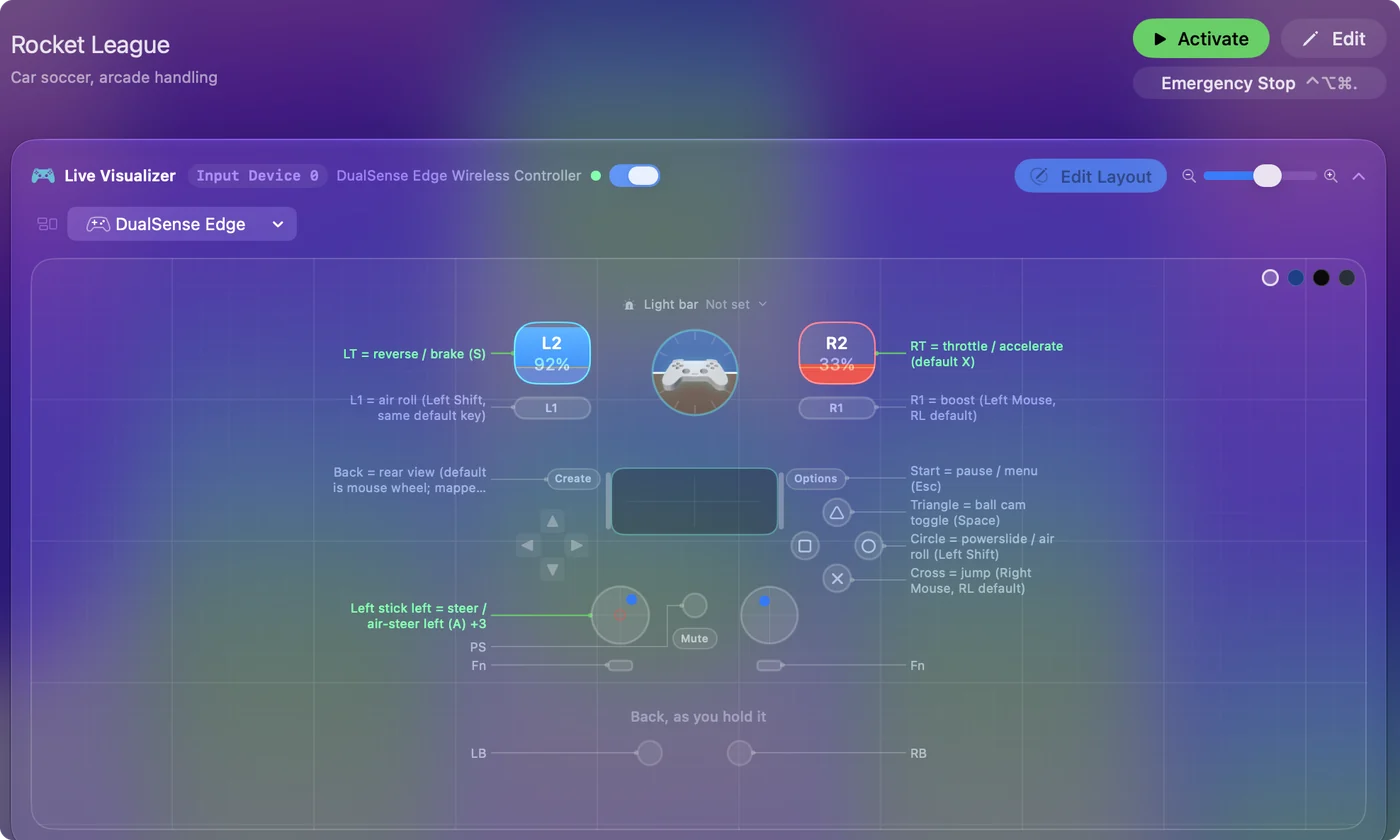
| Controller | Sends | What it does |
|---|---|---|
| Right trigger | X | RT = throttle / accelerate (default X) |
| Left trigger | S | LT = reverse / brake (S) |
| Left stick left | A | Left stick left = steer / air-steer left (A) |
| Left stick right | D | Left stick right = steer / air-steer right (D) |
| Left stick up | W | Left stick up = air pitch up (W) |
| Left stick down | S | Left stick down = air pitch down (S) |
| A / Cross | Right click | Cross = jump (Right Mouse, RL default) |
| RB / R1 | Left click | R1 = boost (Left Mouse, RL default) |
| B / Circle | Shift (Left) | Circle = powerslide / air roll (Left Shift) |
| LB / L1 | Shift (Left) | L1 = air roll (Left Shift, same default key) |
| Y / Triangle | Space | Triangle = ball cam toggle (Space) |
| Back / Share / Select | Middle click | Back = rear view (default is mouse wheel; mapped to Middle Mouse) |
| Start / Options | Escape | Start = pause / menu (Esc) |
Button names follow the Xbox / PlayStation pair shown in the editor, so A / Cross is the bottom face button on either pad. On a Switch Pro Controller the bottom button is labeled B; the mapping still fires on position.
Questions
Does Rocket League run on a Mac?
Not any more. Psyonix ended the Mac version in 2020. It plays on a Mac as a stream, and a stream normally passes your controller to the game.
Why does steering feel twitchy with this layout?
Because the game is receiving keys, which are either on or off. Raise the deadzone on the steering rows, and if you can, get the stream to pass the controller itself, which gives you analog steering.
Does Rocket League have controller support?
Partly. Steam lists partial controller support for Rocket League: it plays on a controller, but some screens still expect a keyboard or mouse.
Is Rocket League better with a controller or a keyboard?
A controller works for most of it. Steam lists partial controller support for Rocket League, so some screens still expect a keyboard or a mouse, and a layout like this one can put those on the pad.
Why is my controller not working in Rocket League on a Mac?
First check the Mac itself sees the controller, with the gamepad tester. If it does and Rocket League still ignores it, activate the Rocket League layout in InputConfig, which sends the game's keyboard and mouse controls from the controller.
Can I play Rocket League on an M1 Mac or a MacBook Air?
Yes, through a stream. Rocket League runs on the other end, on a cloud service or your own PC, so the Mac only plays the video and sends your input. An M1 MacBook Air streams it like any other Mac.
Related
Completely free. You don't have to make an account, there are no subscriptions, and nothing is locked. Optimized for Apple silicon. Open source on GitHub.
Updated